
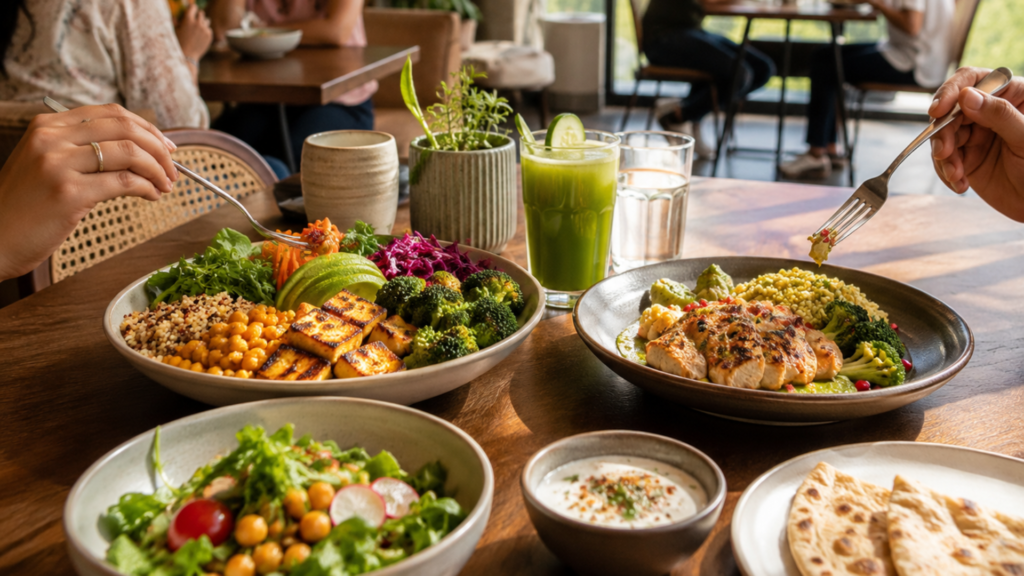
Something quietly significant is happening at restaurant tables across India’s cities. The diner who once ordered a butter-laden dish without a second thought is now scanning the menu for protein content.
The office worker who used to grab a samosa at the canteen is now looking for a wholesome grain bowl. The college student who survived on Maggi and maida is asking whether their lunch has enough fibre.
This is not a passing wellness fad. It is a genuine, data-backed shift in the way urban India thinks about food, and it is reshaping the entire dining industry from the inside out.
How Urban India’s Relationship with Food Changed

For decades, Indian urban dining culture followed a straightforward script: taste came first, everything else was secondary. Richness, indulgence, and abundance were signals of a good meal. A plate piled high was a plate worth paying for.
That script is being rewritten, and the change is generational. In India, 58% of urban consumers now report prioritising nutritional benefits over taste when choosing their food, a figure that actually exceeds the global average of 52%.
Millennials and Gen Z together account for over 60% of health food consumers, making them the single biggest force reshaping restaurant menus today.
Taking into account PwC’s Voice of the Consumer 2025 survey, 84% of Indian consumers now actively seek safer and healthier food choices, with 29% citing health benefits as one of the top three reasons for switching brands.
What’s driving this? A combination of forces: rapid urbanisation, the explosion of fitness culture on social media, higher disposable incomes giving people access to better food choices, and a post-pandemic awareness of how closely diet and long-term health are connected.
The result is a consumer who wants to eat out regularly but wants that meal to actually serve their body.
What “Balanced” Actually Means to the Modern Urban Diner

The word “balanced” gets used loosely, but urban diners in India have a fairly consistent idea of what it means on the plate. It is not about calorie restriction or deprivation.
It is about a meal that covers the nutritional bases, adequate protein, complex carbohydrates, healthy fats, fibre, and genuine freshness without sacrificing flavour or satisfaction.
Protein and fibre have emerged as the dynamic duo of India’s evolving culinary consciousness. The narrative is evolving as consumers become increasingly aware of their dietary choices, leaning into ingredients that deliver both nutrition and genuine flavour.
The mantra emerging across menus is “calorie restriction without malnutrition,” a user-friendly approach to eating mindfully that spotlights fresh fruits, vibrant salads, and comforting preparations while using healthier cooking techniques such as grilling, steaming, fermenting, and slow-roasting.
Menus are being curated with a thoughtful balance of macros and micronutrients to deliver a wholesome, satisfying experience without compromising on taste.
This framing is important. Balanced meals in 2026 are not the sad, joyless salads of a 2010s diet culture. They are full-flavoured, well-portioned plates that happen to also be good for you.
That distinction, nourishing and delicious, not nourishing instead of delicious, is what has made this trend stick.
The Food Bowl Revolution: Convenience Meets Nutrition

Perhaps no format captures the balanced meal trend better than the food bowl. Walk into almost any modern urban eatery today, and you’ll find some version of it: grains at the base, a protein on top, vegetables on the side, a sauce that ties it together.
Bowls are gaining traction for their versatility, customisation, and appeal to health-conscious consumers. The trend is not only about variety but also about providing convenient and wholesome meals that fit today’s busy lifestyles.
Bowls offer a great way to combine flavours and provide a nutritionally balanced meal, all in one package.
The food bowl works because it solves a real problem for the urban professional: they want to eat well, they don’t have much time, and they don’t want to compromise on taste.
A well-built bowl is fast to eat, easy to customise, and carries the visual language of a “good choice” that has become important to a generation that documents their meals on Instagram.
Restaurants responding to this demand are introducing new menu additions like high-protein brown rice bowls, wholesome salad bowls, and light global-inspired dishes that complement signature classics while keeping authenticity intact.
From hummus and falafel platters to quinoa grain bowls, poke-inspired preparations, and classic dal-rice reimagined with better sourcing and portion control, the bowl format has become the primary vehicle through which restaurants are communicating nutritional intent.
India’s Food Service Market Is Betting Big on This Shift

The balanced meal trend is not just a consumer preference, it is a commercial reality that is redirecting significant investment across India’s food service sector.
The India food service market was valued at USD 56.2 billion in 2025, with projections pointing to USD 138.2 billion by 2034 at a CAGR of nearly 10%.
This growth is driven by rapid urbanisation, higher disposable incomes, and a rising inclination for eating out, particularly among millennials and Gen Z, who are more willing to invest in varied, quality dining experiences.
The rise of diet-specific and organic meal services promises to widen the market and bring more health-conscious Indians to restaurants more often. With Gen Z and millennials prioritising sustainability, businesses that adapt to these preferences are gaining a competitive edge.
Restaurants that have identified this shift early and built their menus around honest, balanced, everyday food rather than trend-chasing specialties are the ones attracting consistent, repeat urban customers.
The occasional indulgence restaurant still has its place, but the everyday dining spot built on dependable, nourishing food is becoming the cornerstone of neighbourhood dining culture.
How Platesman in Pune Embodies the Balanced Meal Philosophy

Few eateries in Pune capture the spirit of this shift as naturally as Platesman. Located in Bavdhan, Platesman (platesman.com) positions itself not as a health café or a wellness brand but as an “everyday eatery” built on clean flavours and honest food.
And that, precisely, is what makes it such a strong example of the balanced meal trend done right.
The philosophy at Platesman is straightforward: good food should not be complicated, and nourishment should not feel like a sacrifice.
Every dish is made from fresh ingredients, cooked with care, and portioned sensibly the kind of food you can eat on a regular Tuesday without feeling guilty or heavy. Their menu spans breakfast, mains, and desserts, covering the full arc of a day’s meals with continental and comfort-food preparations that feel grounded rather than gimmicky.
What’s notable about Platesman’s approach is that “balanced” is expressed through their food philosophy rather than marketed as a health pitch. You will not find calorie counters or wellness buzzwords plastered across their menu.
What you will find is a hummus and falafel plate made with real ingredients, a pasta that is fresh rather than reheated, and protein-forward preparations that leave you full without that sluggish aftermath that heavy meals often bring.
For the urban Pune professional, whether working from a café in Bavdhan or grabbing a quick lunch between meetings, this is exactly what balanced dining looks like in practice. It is not a special effort; it is just a place where the default is food that is made well.
Platesman also offers catering, corporate meal orders, and subscription plans, a strong signal that they understand balanced eating is not just a once-in-a-while choice but a daily need for urban consumers who have stopped separating “eating well” from “eating out.”
Their partnership with Nelda, Pune’s tree-planting initiative, adds a layer of environmental mindfulness that resonates with the same generation driving the balanced meal trend.
Open every day from 8 AM to 11 PM, Platesman at Bavdhan makes balanced everyday dining genuinely accessible, one of the few real barriers that has historically kept health-conscious eating as an aspirational choice rather than an everyday reality.
The Role of Restaurants in Shaping Healthier Habits — Without Preaching

One of the more nuanced observations about this trend is how the most successful restaurants are influencing eating behaviour without being preachy about it. Urban diners in 2026 are well-informed and resistant to being lectured about nutrition.
What they respond to is a restaurant that simply makes the healthy option the delicious option.
Restaurants play an active role in educating diners about conscious eating without being preachy. Dropping subtle hints in the menu, the restaurant interior, or on the tableware can organically bring a lot of attention to balanced eating as a lifestyle rather than a regime.
Health and wellness are reshaping India’s food culture, driving a strong demand for nutritious, sustainable, and personalised dining options.
Restaurants are evolving to meet the needs of increasingly conscious consumers seeking balanced, flavorful, and health-supportive meals, and demand for protein-rich, low-carb, and superfood dishes reflects growing fitness awareness without sacrificing flavour or convenience.
The best positioning a restaurant can have right now is simply: “We make food that is genuinely good for you and genuinely delicious.” No certification required. No lengthy explanation. Just the food doing the talking.
Traditional Wisdom Meets Modern Plates

There is something deeply Indian about the balanced meal philosophy, even if its current urban expression looks different from what previous generations ate. The traditional thali, a complete arrangement of grains, lentils, vegetables, dairy, and condiments, was built on the exact principles of nutritional balance that modern diners are now rediscovering.
Meals like the traditional thali bring together a variety of dishes that balance taste and nutrition on one plate. Ancient wisdom like Ayurveda influenced how people chose ingredients based on the weather and the body’s needs.
Even today, these age-old practices continue to shape India’s evolving food habits, blending tradition with new dining trends.
The contemporary balanced meal is, in many ways, the thali reinvented for the urban, mobile, globally-influenced consumer. Different in format. Identical in intent.
Urban grocery baskets, especially in metro cities, now showcase greater inclusion of whole grains, millets, and lean proteins, a real shift driven by both awareness and accessibility. Dietary diversity has expanded meaningfully in urban centres, with more Indians eating micronutrient-rich foods than five years ago.
What This Means for the Future of Urban Dining in India
The balanced meal trend is not going to reverse. The demographic driving it, urban millennials and Gen Z, is growing in both size and purchasing power.
The food service market is expanding rapidly. And the cultural permission to eat healthily every day, without it being a special effort or an expensive choice, is firmly established.
What this means practically is that the restaurants best positioned for the next decade are not the ones chasing spectacle and novelty, but the ones building honest, consistent, well-sourced everyday menus.
The neighbourhood eatery that you trust to feed you well every single week will become the anchor of urban dining in India in a way it never has been before.
The shift has already begun. On plates across Pune, Mumbai, Bengaluru, and Delhi, balanced meals are quietly becoming the new normal. And the eateries that understood this early and built their entire identity around it are the ones that will fill their tables for years to come.


